Why Your Driver Isn’t Flat (And Why That’s a Very Good Thing)
Ok, don’t laugh… actually, go ahead – it’s funny now.
I discovered this a while back, but I’m just now posting it because it felt worth sharing.
Maybe only if you’re a golf addict like me who wants to understand the why behind things.
At the time, I remember thinking:
“Why did they do that?!”
When I first got into golf, I was slicing the heck out of my driver and couldn’t figure out why.
Then I looked down at the club and thought:
“Wait… this isn’t flat. That can’t be right.”
I honestly thought it was a manufacturing defect.
So naturally, I tried even harder to hit it perfectly square – you know, find the sweet spot.
Still slicing.
Sometimes hooking.
Mostly slicing.
That slice? Turns out, that’s gear effect (different post for a deeper dive – but we’ll touch on it here).
And yes… this led to the first – and only – time I “accidentally” broke a golf club.
So I did what any reasonable golfer would do…
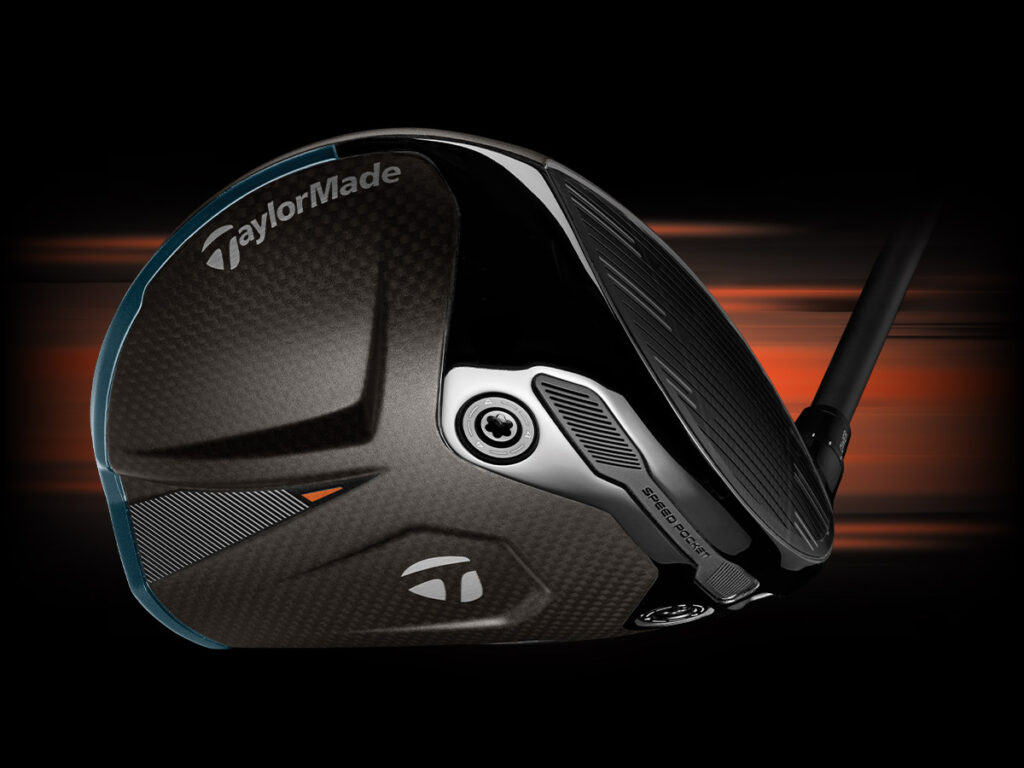
Went to Golf Galaxy and bought a new driver. A TaylorMade Qi10. I felt like my long game was about to instantly improve. Maybe even Rory level.
But then… same thing.
Not flat. Still curved.
At that point, I was officially going down the rabbit hole – researching, fact-checking, trying to figure out what was going on.
And then it clicked.
One of those real “ah-ha” moments.
The driver wasn’t defective.
It was designed that way – on purpose.
Turns out… the problem wasn’t the club.
It was that I didn’t understand what the club was trying to do.
Now, did this instantly fix my swing?
No.
But understanding gear effect – and why the face is curved – changed how I practiced and how I thought about my misses.
And over time?
Less slicing.
More consistency.
Better direction.
More distance.
Go figure.
Hope this helps you too.
Settle in. Let’s talk golf.
At address, your driver looks… clean.
Powerful. Forgiving. Modern.
But here’s something most golfers don’t realize:
That face isn’t flat. Not even close.
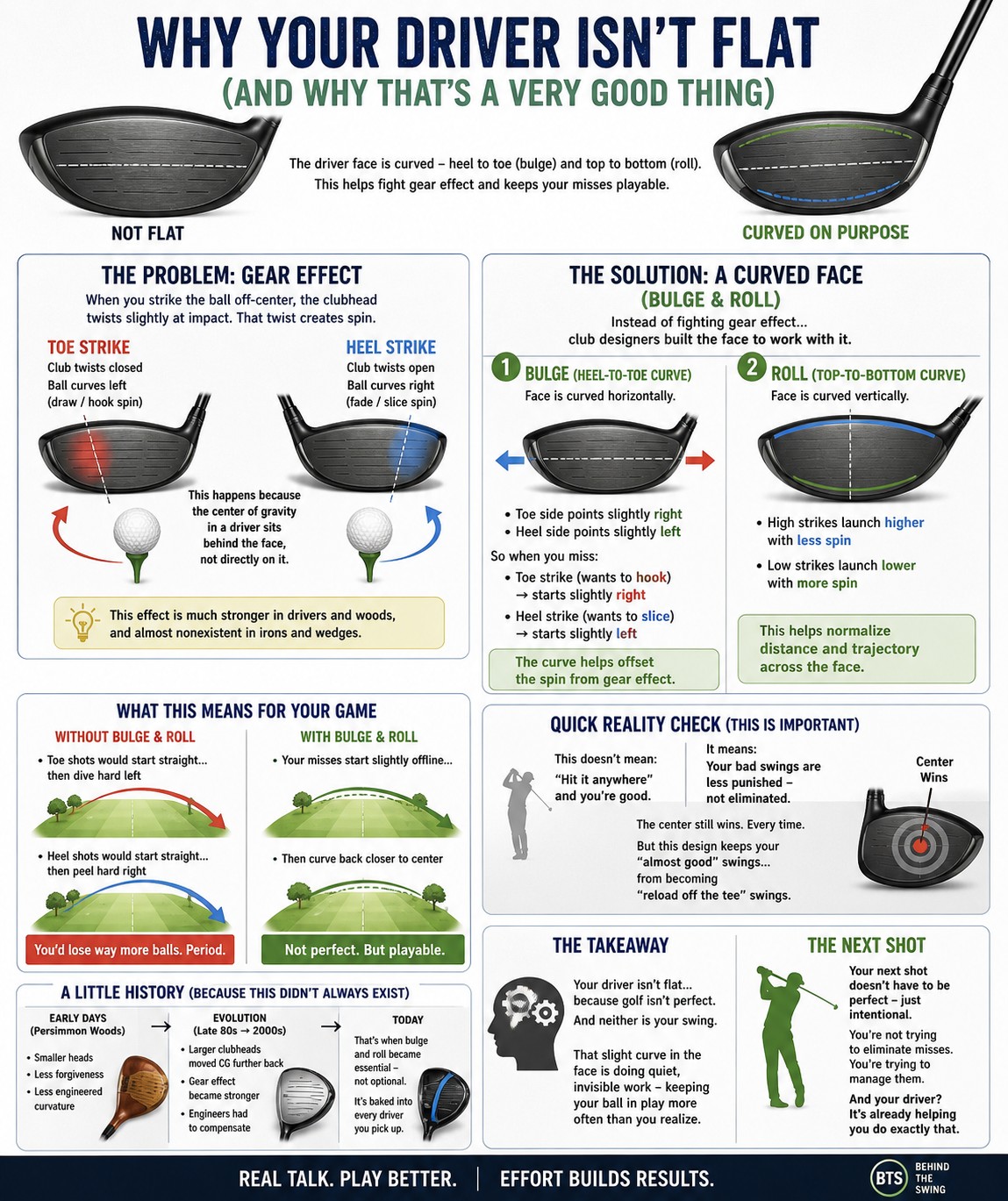
It’s subtly curved – heel to toe, and top to bottom.
And that tiny design detail?
It might be one of the biggest reasons your tee shots stay anywhere near the fairway.
The Problem: You Don’t Hit the Center (Consistently)
Let’s be honest.
Even good players don’t live in the dead center of the face.
• A little off the toe
• A little off the heel
• Sometimes… a lot off the toe
And with a flat-faced driver?
Those misses would be brutal.
Why?
Because of something called gear effect.
Gear Effect (The Hidden Force You Don’t See)
When you strike the ball off-center, the clubhead twists slightly at impact.
That twist creates spin:
• Toe strike → ball curves left (draw/hook spin)
• Heel strike → ball curves right (fade/slice spin)
This happens because the center of gravity in a driver sits behind the face, not directly on it.
So instead of a clean, straight transfer of energy…
You get a little side-spin surprise.
This effect is much stronger in drivers and woods,
and almost nonexistent in irons and wedges (where the CG is closer to the face).
The Solution: A Curved Face (Bulge and Roll)
Now here’s where club designers got smart.
Instead of fighting gear effect…
They built the face to work with it.
Every modern driver has two key design features:
1. Bulge (Heel-to-Toe Curve)
The face is curved horizontally.
• Toe side points slightly right
• Heel side points slightly left
So when you miss:
• Toe strike (which wants to hook) → starts slightly right
• Heel strike (which wants to slice) → starts slightly left
The curve helps offset the spin from gear effect.
2. Roll (Top-to-Bottom Curve)
The face is also curved vertically.
• High strikes launch higher with less spin
• Low strikes launch lower with more spin
This helps normalize distance and trajectory across the face.
What This Means for Your Game
Without bulge and roll:
• Toe shots would start straight… then dive hard left
• Heel shots would start straight… then peel hard right
You’d lose way more balls. Period.
With it:
• Your misses start slightly offline…
• Then curve back closer to center
Not perfect.
But playable.
Quick Reality Check (This Is Important)
This doesn’t mean:
“Hit it anywhere and you’re good.”
It means:
Your bad swings are less punished – not eliminated.
The center still wins. Every time.
But this design keeps your “almost good” swings…
From becoming “reload off the tee” swings.
A Little History (Because This Didn’t Always Exist)
Early drivers – especially persimmon woods – had much less sophisticated face shaping.
• Smaller heads
• Less forgiveness
• Less engineered curvature
As metal woods evolved (late 80s → 2000s):
• Larger clubheads moved CG further back
• Gear effect became stronger
• Engineers had to compensate
That’s when bulge and roll became essential – not optional.
Today?
It’s baked into every driver you pick up.
The Takeaway
Your driver isn’t flat…
Because golf isn’t perfect.
And neither is your swing.
That slight curve in the face is doing quiet, invisible work –
keeping your ball in play more often than you realize.
The Next Shot
Your next shot doesn’t have to be perfect – just intentional.
You’re not trying to eliminate misses.
You’re trying to manage them.
And your driver?
It’s already helping you do exactly that.
Real Talk. Play Better.
Effort builds results.